#1 Prop Firm Knowledge Hub

All-in-One Resource for Prop Trading Firms

Comprehensive guides on starting, funding, and scaling a proprietary trading company. Over 50 expert articles to help you build your trading firm from the ground up.
50+ Expert Articles
18+ Topics Covered
100% Free Access
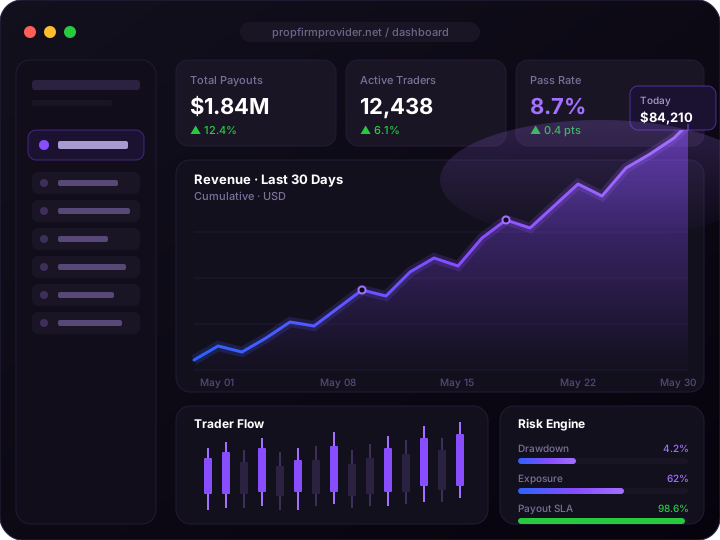
Prop Firm Dashboard

Scale Your Trading Firm
with Precision and Control

Automate payouts, enforce challenge rules, and monitor risk in real time — everything a prop firm founder needs.

Challenge Engine
Challenge & Payout Engines
Set up multi-phase challenges with fully automated payouts. Risk rules applied in real time.
Risk Intelligence
Smart Fraud & Risk Intelligence
Continuous real-time checks detect and prevent threats before they impact your firm.
Real-time Monitoring
Track performance in real time with live dashboards that surface key metrics to drive growth.
Automations
End-to-end Automations
Connect operations with automated workflows that cut errors and scale efficiency.
Actionable Reports
From insight to impact — reports reveal key drivers to halt growth and stay ahead of the market.
Affiliate Growth Engine
Integrated affiliate management tools that reward partners and drive sustainable growth.

Scale. Speed. Control.

PropFirm Provider is the authoritative resource for modern trading firms. Automation-first infrastructure, real-time risk oversight, and global scale backed by measurable results.

50+
Expert articles published
18+
Topics covered
100%
Free access to all guides
24/7
Available resources

Everything you Need to Run and
Grow your Prop Firm

A comprehensive technology platform built for prop trading firms. Streamline operations and deliver an efficient, end-to-end experience.

  1. 1 Checkout Made Simple — optimise checkout flow for smooth conversion.
  2. 2 Fully Flexible Challenges — customise multi-phase challenges.
  3. 3 Seamless Compliance — automated KYC, AML, and reporting.
  4. 4 Engaging Competitions — leaderboards and trader competitions.
  5. 5 Clever Integrations — 100+ integrations out of the box.
  6. 6 Data That Drives Decisions — real-time analytics dashboard.
  7. 7 Affiliate Growth Engine — reward partners, scale revenue.
Platform Demo

100+ Integrations Out Of The Box

Connect your prop firm with the tools you already use — brokers, payment providers, CRMs and more.


Run your Prop Firm with
Confidence, Speed, and Control

Track challenges, enforce challenge rules, and monitor all trades in real time — all from one white-label platform purpose-built for prop firms.

About PropFirm Provider

Your Prop Trading Knowledge Hub

The definitive guide to starting, operating, and scaling a proprietary trading firm — from legal setup and technology selection to marketing and growth strategy.

Starting a Prop Firm: The Complete Playbook
Essentials

Launching a proprietary trading firm in 2026 requires a strategic blend of technology, capital, legal structure, and marketing expertise. The barrier to entry has dropped dramatically — from $500K+ and 12 months to as little as $15K-30K and 3-4 weeks using white-label technology — but the barrier to success remains high.

Roughly 800+ prop firms are currently active globally, and the top 10% capture over 70% of total market revenue. Understanding what separates the winners from the 40%+ that fail in year one is essential before you invest a dollar.

$15-30K
Minimum to Launch
800+
Active Firms
40%+
Year-1 Failure Rate

The Prop Firm Business Model

Revenue comes from three primary sources: challenge fees (60-75% of total revenue), recurring subscription fees for funded traders (10-20%), and the statistical edge on funded accounts where most traders eventually breach drawdown limits (10-20%). The model works because approximately 70-85% of funded traders ultimately fail to maintain profitability within risk parameters.

Critical Understanding

The prop firm model is a volume business built on statistical probability. You need consistent monthly challenge purchases (200+ minimum for viable economics) and strong brand trust to generate referrals. Underfunded marketing is the #1 reason new firms fail.

Pre-Launch Assessment

Before committing capital, honestly assess these five factors:

  • Do you have $30K-75K in startup capital (including 6-month runway)?
  • Do you understand trading enough to configure sensible evaluation rules?
  • Can you differentiate your offering in a crowded market?
  • Do you have marketing expertise or budget to acquire it?
  • Are you prepared for the operational demands of running a financial services business?
Failure rate and revenue distribution data from PropTrading.com Industry Report 2025.
Business legal documents and compliance setup
Legal Structure & Regulatory Compliance
Legal Setup

The legal foundation of your prop firm determines everything from tax efficiency to regulatory exposure. Getting this wrong is expensive to fix and potentially catastrophic if regulators come knocking.

Choosing a Jurisdiction

JurisdictionEntity TypeRegulatory StatusTax RateSetup Time
UAE (Dubai/RAK)Free Zone LLCVARA oversight for crypto0-9%2-4 weeks
UKLtd CompanyFCA awareness (not regulated)19-25%1-2 weeks
US (Wyoming/Delaware)LLCCFTC/NFA watching21% federal + state1 week
St. Vincent & GrenadinesIBCMinimal regulation0%1-2 weeks
CyprusLtd CompanyCySEC potential12.5%2-3 weeks

Essential Legal Documents

  • Terms of Service: Must clearly define the evaluation nature, risk disclaimers, and refund policy
  • Privacy Policy: GDPR-compliant if serving EU customers, CCPA for California
  • KYC/AML Policy: Know Your Customer procedures for funded traders receiving payouts
  • Payout Policy: Clear timelines, methods, and conditions for profit withdrawals
Legal Requirement

Never market funded accounts as 'investment opportunities' or 'guaranteed income.' These characterizations can trigger securities regulation in multiple jurisdictions. Use precise language: 'simulated trading evaluation' and 'performance-based profit sharing.'

Technology Selection & Setup
Technology

Your technology choice is the second most important decision after marketing strategy. It determines your operational capacity, trader experience, and cost structure for the foreseeable future. Switching providers later costs $20K-50K+ and 4-8 weeks of disrupted operations.

Evaluating Technology Providers

CriteriaWeightWhat to Look For
Risk Engine QualityCriticalReal-time tick-level monitoring, configurable rules
Platform SupportHighMT5 + at least one alternative (cTrader, DXtrade)
Admin PanelHighIntuitive, comprehensive, fast-loading
API CoverageMediumRESTful APIs for integrations
ScalabilityMediumCan handle 10K+ concurrent traders
Support QualityHighResponse time < 4 hours, dedicated contact
Pricing TransparencyHighAll-in pricing, no hidden fees
Vendor Selection

Narrow your list to 3 providers, then request 2-week trial access to each platform's admin panel. Run simulated operations: create accounts, configure challenges, process mock payouts. Your daily experience as an operator matters as much as the trader experience.

Implementation Timeline

A typical white-label implementation follows this sequence:

  • Week 1: Contract, branding assets, domain setup
  • Week 2: Platform configuration, payment integration
  • Week 3: Internal testing, beta trader group
  • Week 4: Soft launch, limited marketing
Digital marketing strategy and growth analytics
Marketing & Trader Acquisition
Growth Strategy

Marketing is the make-or-break function for prop firms. Technology is table stakes — differentiation comes from brand positioning, acquisition channels, and the ability to convert prospects into challenge purchases at a sustainable cost.

Customer Acquisition Costs

$25-80
Avg. CAC
$250-400
Avg. Challenge Fee
5-8x
Healthy LTV:CAC

Channel Strategy

Successful prop firms typically use a multi-channel approach, with affiliate marketing driving 40-60% of revenue:

  • Affiliate/IB Programs: Offer 15-25% commission per challenge purchase. Build a network of trading educators, YouTubers, and bloggers.
  • Paid Social: Instagram and YouTube ads targeting trading audiences. CPAs of $30-60 per challenge purchase are achievable.
  • SEO Content: Long-form content targeting "how to start prop trading," "best prop firms," and comparison keywords.
  • Community Building: Discord servers and Telegram groups for trader engagement and organic referrals.

We spent our first $50K on paid ads and got mediocre results. Then we invested $10K in an affiliate program and it generated 3x the revenue. In prop trading, word-of-mouth through trusted trading educators is worth more than any ad campaign.

— Founder of a European prop firm that scaled to $500K/month revenue in 14 months
Financial Planning & Capital Management
Capital

Undercapitalization is the silent killer of prop firms. Challenge revenue looks great on paper, but payout obligations, marketing spend, and operational costs can drain reserves faster than most founders anticipate.

Startup Budget Template

CategoryMinimumRecommended
Technology setup$5K-15K$15K-30K
Legal & entity$2K-5K$5K-10K
Marketing (first 3 months)$5K-15K$15K-30K
Payout reserve$10K$25K-50K
Operations (3-month runway)$5K-10K$10K-20K
TOTAL$27K-55K$70K-140K
Cash Flow Warning

Challenge fees are collected upfront but payouts happen 2-8 weeks later. During growth phases, your payout obligations can spike unexpectedly. Always maintain a minimum payout reserve equal to 15% of total funded account balances.

Operational Risk & Fraud Prevention
Operations

Prop firms face operational risks that can materialize rapidly: payment processor freezes, trader fraud rings, technology outages, and reputation attacks. Building resilience into your operations is essential.

Key Operational Risks

  • Payment processor risk: Maintain accounts with 2+ processors. Stripe, crypto, and a backup gateway.
  • Fraud exposure: Implement copy-trade detection and IP correlation from day one
  • Reputation risk: Monitor social media and review sites. Respond to complaints within 24 hours
  • Technology outage: Ensure your provider has 99.9%+ uptime SLA with financial penalties
Fraud Prevention

Cross-reference trader IP addresses, device fingerprints, and trade timing patterns across all accounts. Copy-trading rings often operate from the same IP range or enter trades within milliseconds of each other — automated detection catches what manual review cannot.

Industry Benchmark

Well-run prop firms maintain a fraud loss rate below 2% of total payouts. Firms without automated detection tools typically experience 5-10% fraud exposure — the difference goes straight to your bottom line.

Scaling Your Prop Firm: $100K to $1M/Month
Growth Path

Reaching $100K/month in challenge revenue is achievable within 6-12 months for well-executed operations. Scaling from there to $1M/month requires systematic improvements in marketing efficiency, operational automation, and product diversification.

Growth Milestones

Revenue TierKey FocusTeam SizeMonthly Challenges
$0-25K/moProduct-market fit, first reviews1-2 people50-100
$25K-100K/moAffiliate program, paid acquisition3-5 people100-400
$100K-500K/moBrand building, multi-platform5-10 people400-1,500
$500K-1M/moDiversification, global expansion10-20 people1,500-3,500
$1M+/moEnterprise partnerships, regulation20+ people3,500+

Scaling Levers

Geographic expansion: Translate your platform into 5-10 languages and run localized marketing. Southeast Asia, Latin America, and Africa are high-growth regions with rapidly expanding trading communities.

Product diversification: Add account sizes, challenge types (1-step, 2-step, instant funding), and asset classes. Each new product variant is a new entry point for different trader segments.

Technology moat: As you scale past $500K/month, consider custom technology development to differentiate your trader experience and reduce per-unit technology costs.

Every $100K/month milestone requires a fundamentally different operational approach. What gets you to $100K will not get you to $500K. The firms that scale are those willing to rebuild their operations every 6-12 months.

— Operating partner at a prop firm that grew from zero to $2M/month in 22 months